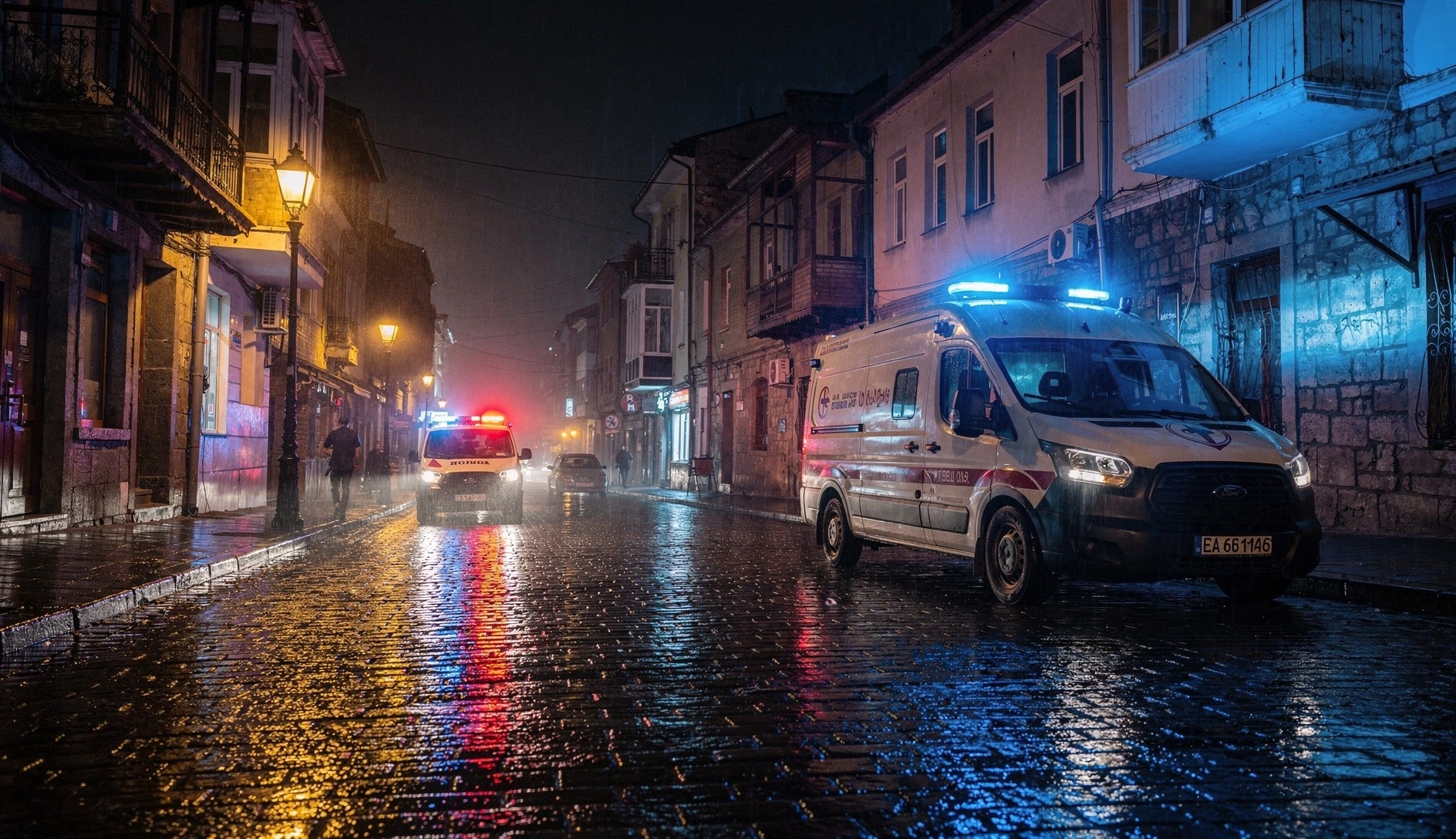
Nobody moves to a new country expecting things to go wrong. But eventually something will — a medical emergency at 3 AM, a fender bender on Rustaveli, a wallet lifted at a bar, or an earthquake that rattles your Soviet-era building. Georgia's emergency infrastructure is actually better than most expats expect, but knowing how it works before you need it makes the difference between a stressful few hours and a genuine crisis. Save this page. You'll be glad you did.
Save These Numbers Now
Add 112 to your phone contacts right now. It works from any phone — even without a SIM card, even if your balance is zero, even from a locked screen. It connects to police, ambulance, and fire simultaneously. Operators speak English (though quality varies). If you remember nothing else from this article, remember 112.
Essential Emergency Numbers
Georgia unified its emergency services under 112 in 2012, modeled on the EU system. One number handles everything. But there are also direct lines if you know exactly what you need.
| Service | Number | English | Notes |
|---|---|---|---|
| Emergency (all services) | 112 | Yes | Free from any phone, 24/7. Primary number for everything. |
| Patrol Police | 022 241 41 41 | Limited | Direct police line. 112 is usually faster. |
| Ambulance | 113 | Limited | Direct ambulance dispatch. |
| Fire Department | 111 | Limited | Direct fire service. |
| Gas Emergency | 114 | No | Gas leak or smell. Also report via 112. |
| Anti-Corruption Hotline | 116 006 | Yes | Report bribery demands from officials. |
| Domestic Violence Hotline | 116 006 | Yes | 24/7, confidential. |
| Mountain Rescue | 112 | Yes | Search & rescue for hiking/climbing incidents. |
How 112 Actually Works
When you call 112, an operator answers and asks what you need: police, ambulance, or fire. They can also dispatch mountain rescue. The system automatically detects your location via cell tower (GPS if available). English-speaking operators are available, but if you get someone who doesn't speak English, stay on the line — they'll transfer you. In the worst case, just clearly say your location and "ambulance" or "police." They'll understand.
Medical Emergencies
This is the one most expats worry about. The good news: Georgia's private hospitals are genuinely good — modern equipment, trained doctors, many with European or American education. The less good news: the public ambulance system is basic, and you'll get better care by going directly to a private hospital if you can.
What to Do
| Situation | Action |
|---|---|
| Life-threatening (chest pain, severe bleeding, stroke symptoms) | Call 112 immediately. Don't drive yourself. Ambulance is free. |
| Serious but stable (broken bone, deep cut, high fever) | Take a Bolt/taxi to the nearest private hospital ER. Faster than waiting for an ambulance. |
| Urgent but not emergency (infection, persistent pain, allergic reaction) | Call your insurance company's hotline first, then go to a clinic. Some offer 24/7 home visits. |
| Minor (flu, mild injury, medication needed) | Visit a pharmacy (many medications available without prescription) or book a clinic appointment. |
Best Hospitals for Expats in Tbilisi
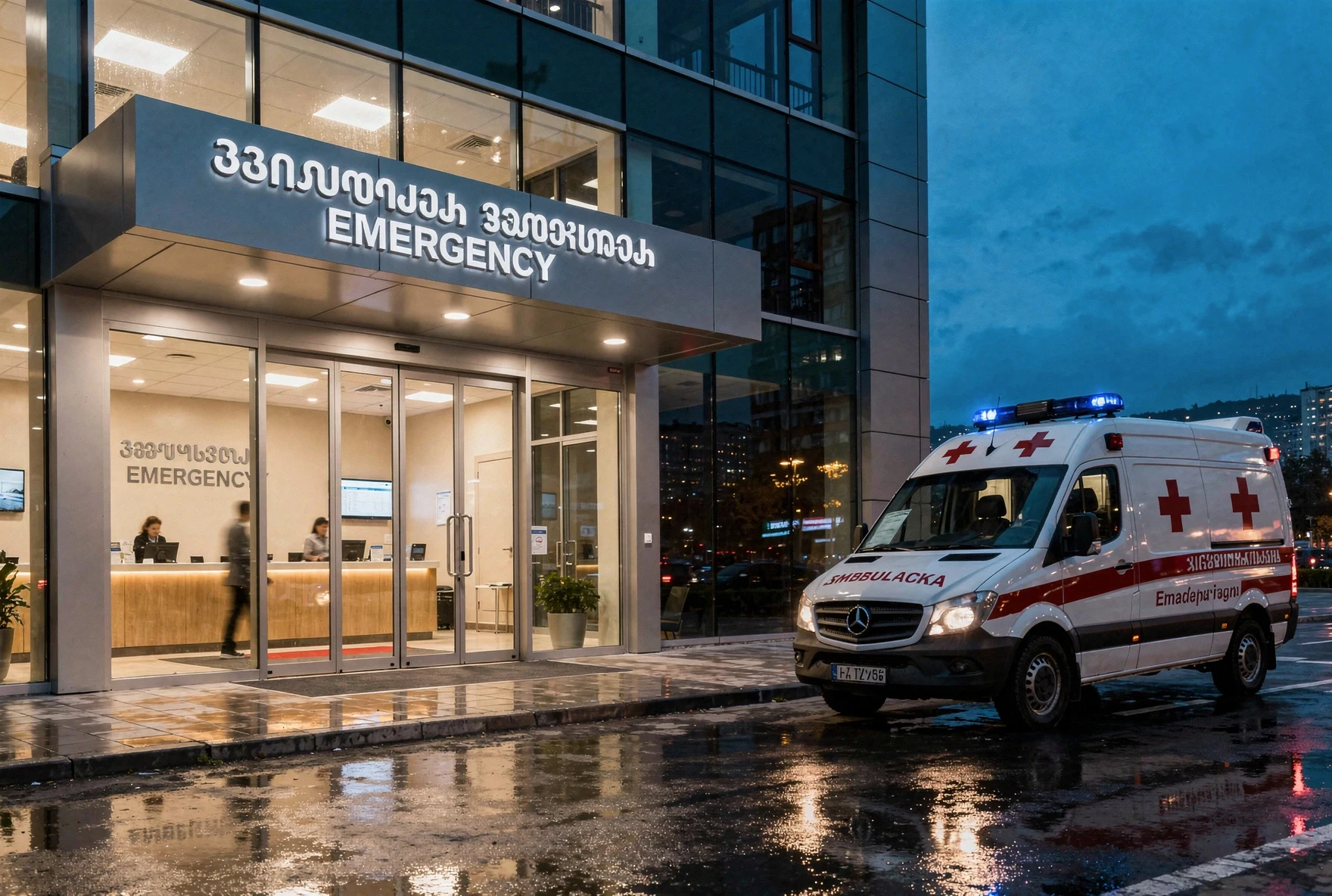
Not all hospitals are equal. These are the ones expats should know about — all have English-speaking staff and modern facilities:
| Hospital | Location | ER | English | Best For |
|---|---|---|---|---|
| Todua Clinic | Digomi | 24/7 | Good | Diagnostics, surgery, MRI/CT. Best overall private hospital. |
| New Hospitals | Saburtalo | 24/7 | Good | European-standard care, 285 beds. Strong all-rounder. |
| Evex Clinics | Multiple locations | 24/7 | Varies | Largest chain (35+ facilities). Most convenient — there's one in every district. |
| American Medical Center (AMC) | Saburtalo | 24/7 | Excellent | Expat-focused. English-speaking GPs and pediatricians. Home visits available. |
| MediClub Georgia | Vake | 24/7 | Excellent | On U.S. Embassy's recommended list. International-standard clinic. |
| National Center of Surgery | Digomi | 24/7 | Good | Complex surgery, cardiac care. Serious emergencies. |
ER Costs Without Insurance
An ER consultation at a private hospital typically costs 50–100 GEL ($18–$35). Basic X-rays: 30–80 GEL. Blood work: 20–60 GEL. An MRI scan: 300–500 GEL. A night in hospital: 200–400 GEL. Compared to Western prices, it's shockingly affordable — but it adds up without insurance. Most hospitals accept cash and card. Insurance pre-authorization can delay treatment, so pay upfront and claim later if time is critical.
Ambulance Reality Check
The state ambulance service (called via 112) is free. It will come. But ambulances in Georgia are essentially transport — the paramedics provide basic stabilization, not advanced emergency care. They'll bring you to the nearest public hospital, which may not be the one you'd choose.
Practical advice from long-term expats: for anything short of a genuine life-threatening emergency where you can't be moved, take a Bolt taxi to your preferred private hospital. It's often faster, and you get to choose which facility you end up at. For serious trauma, call 112 — let the professionals handle it.
Dealing with the Police
Georgian police have been completely reformed since the Rose Revolution in 2003. The old corrupt Soviet-era force was fired — all of them — and replaced with a new, Western-trained service. Patrol police are generally professional, non-corrupt, and reasonably helpful. That said, there are things to know as a foreigner.
🪪 ID Requirement
Foreigners are legally required to carry ID (passport or residence card). Police can ask. In practice, a photo of your passport on your phone is usually fine for routine checks, but carry the original if you're driving or going through any official process.
🚔 Traffic Stops
If stopped while driving, police will ask for your license, registration, and insurance. They have portable card readers for on-the-spot fines. Don't try to negotiate or bribe — Georgian police are genuinely non-corrupt and you'll make things worse.
📋 Filing a Report
For theft, assault, or property crime, go to any police station or call 112. Reports can be filed in English at the Patrol Police Department. You'll get a case number — keep it for insurance claims. Expect the process to take 1–3 hours.
⚖️ If Arrested or Detained
You have the right to an interpreter and to contact your embassy immediately. Don't sign anything you don't understand. Georgia has a 48-hour limit before charges must be filed or you're released. Ask for a lawyer — court-appointed ones are available.
Drug Laws Are Strict
Georgia has recently liberalized marijuana possession laws (the Constitutional Court decriminalized personal use), but other drugs carry severe penalties. Possession of harder substances can mean 6–12 years in prison. The legal system is not lenient with foreigners on drug charges. Police do test for drugs during traffic stops. Don't assume Georgian drug enforcement works like wherever you came from.
If You're Robbed or Pickpocketed
Georgia has very low crime rates — lower than most of Western Europe — but petty theft does happen, especially in tourist-heavy areas, crowded buses, and nightlife districts. Here's the step-by-step:
| Step | Action | Why |
|---|---|---|
| 1 | Get to a safe location | Don't chase or confront the thief. Personal safety first. |
| 2 | Call 112 or go to the nearest police station | File a report immediately. You need the case number for insurance. |
| 3 | Block stolen bank cards | Call your bank or use mobile banking app. BOG and TBC apps let you freeze cards instantly. |
| 4 | If passport stolen: contact your embassy | They'll issue an emergency travel document. See embassy contacts below. |
| 5 | Photograph the police report | You'll need it for insurance claims and embassy paperwork. |
| 6 | Notify your insurance company | Most policies require notification within 24–48 hours of the incident. |
Tbilisi has extensive CCTV coverage, especially in the city center. Police are often able to track thieves through camera footage, and recovery rates for reported theft are surprisingly decent. But file the report quickly — the longer you wait, the harder it gets.
Car Accidents
Tbilisi drivers are... spirited. If you drive in Georgia, minor fender-benders are practically inevitable. Here's the protocol:
| Step | Action |
|---|---|
| 1. Stop and check for injuries | If anyone is hurt, call 112 immediately. Do not move injured people unless there's immediate danger (fire, traffic). |
| 2. Don't move vehicles (if possible) | Leave cars where they are until police arrive. Turn on hazard lights. Place a warning triangle if you have one. |
| 3. Call 112 | Police must attend any accident with injuries or significant damage. They'll file the official report. For minor bumps, both parties can agree to handle it privately — but this is risky without a police report. |
| 4. Document everything | Photos of damage (both cars, multiple angles), the scene, license plates, the other driver's ID and insurance info. Video is even better. |
| 5. Exchange information | Name, phone, insurance company, policy number, license plate. Get witnesses' contact info if possible. |
| 6. Get the police report | The police protocol (ოქმი / oqmi) is the official document. Get a copy — your insurance company will need it. |
| 7. Contact your insurance | Most Georgian insurers require notification within 24 hours. Submit the police report and photos. |
The "Private Settlement" Problem
It's common for Georgian drivers to suggest handling an accident privately — cash on the spot, no police. This can work for tiny scratches, but it's risky for foreigners. Without a police report, you have zero legal protection if the other party later claims more damage, or if their "friend" at a body shop inflates the repair cost. Always get a police report for anything beyond a parking lot scuff. The other driver may protest — stand firm. Call 112.
Lost or Stolen Passport
Losing your passport abroad is stressful but not catastrophic. Georgia handles this better than many countries because Public Service Hall is extremely efficient. Here's the process:
| Step | What to Do | Time |
|---|---|---|
| 1. File a police report | Call 112 or go to any police station. Get the report number. | 1–2 hours |
| 2. Contact your embassy | Call during business hours, or use emergency after-hours number. | Same day |
| 3. Get emergency travel document | Your embassy will issue a temporary passport or ETD. Bring police report + photos. | 1–5 days |
| 4. Notify Georgian immigration | If you have a residence permit, visit Public Service Hall to update records. | 1 day |
Pro tip: Keep a digital copy of your passport (photo of the main page + visa stamps) in a secure cloud storage or email it to yourself. Also keep copies of your residence permit, insurance policy, and any Georgian ID documents. If your phone is also stolen, you can access these from any device.
Embassy & Consulate Contacts
Your embassy is your lifeline for serious problems abroad — lost passports, arrest, serious illness, or death of a relative. Most embassies in Tbilisi are clustered around Vake and Vera neighborhoods.
| Country | Phone | Emergency | Location |
|---|---|---|---|
| 🇺🇸 United States | +995 32 227 7000 | Same number, 24/7 | 11 George Balanchine St |
| 🇬🇧 United Kingdom | +995 32 227 4747 | +44 20 7008 5000 | 51 Krtsanisi St |
| 🇩🇪 Germany | +995 32 244 7300 | +49 30 1817 0 | 166 David Aghmashenebeli Ave |
| 🇫🇷 France | +995 32 272 1490 | +33 1 43 17 53 53 | 49 Krtsanisi St |
| 🇳🇱 Netherlands | +995 32 227 6200 | +31 247 247 247 | 20 Telavi St |
| 🇹🇷 Turkey | +995 32 225 2072 | Same number | 35 Chavchavadze Ave |
| 🇮🇱 Israel | +995 32 255 6500 | Same number | 61 David Aghmashenebeli Ave |
| 🇮🇷 Iran | +995 32 291 3656 | Same number | 80 Chavchavadze Ave |
EU Citizens Without an Embassy
If your country doesn't have an embassy in Tbilisi (many smaller EU nations don't), you can get consular assistance from any other EU member state's embassy. This is an EU right under the Lisbon Treaty. The German, French, or Dutch embassies are good choices — they're all well-staffed and accustomed to helping EU citizens from other countries.
Natural Disasters & Environmental Hazards
Georgia sits in a seismically active zone where the Arabian and Eurasian tectonic plates meet. The country also experiences flooding, landslides, and severe weather. Here's what to know:
🏚️ Earthquakes
Georgia experiences minor earthquakes regularly — you'll feel a tremor every few months in Tbilisi. The last significant quake was in 2002 (magnitude 4.8, some building damage). Most Soviet-era buildings weren't built to modern seismic standards. If you live in an older building, know your exit routes. During a quake: drop, cover, hold. After: check for gas leaks, stay away from damaged structures.
🌊 Flooding
Tbilisi's worst natural disaster in recent memory was the June 2015 flood — the Vere River overflowed, killing 20 people and destroying the zoo (animals escaped into the streets). Flash flooding happens during heavy spring and summer rains, especially in Vake and near the Vere riverbed. Avoid underpasses and low-lying areas during heavy downpours.
🏔️ Landslides
Mainly a risk on mountain roads, especially the road to Tusheti, the Georgian Military Highway, and rural Svaneti. Spring and early summer are worst. Check road conditions before mountain trips. The Emergency Management Agency posts warnings on their Facebook page (in Georgian, but Google Translate works).
🥶 Extreme Cold & Snow
Tbilisi rarely goes below -5°C, but power and gas outages happen occasionally in winter. Mountain regions get genuinely dangerous cold. Keep emergency supplies: flashlight, warm blankets, bottled water, charged power bank. Utility outages are usually resolved within hours in Tbilisi.
Pharmacies & Medication
Georgia has a wonderfully relaxed pharmacy system compared to most Western countries. Many medications that require prescriptions elsewhere are available over the counter here. This is both convenient and potentially dangerous — know what you're doing.
| What You Need | Prescription Required? | Notes |
|---|---|---|
| Antibiotics | Officially yes, practically no | Most pharmacies sell them without asking. Don't self-prescribe if you can avoid it. |
| Painkillers (ibuprofen, paracetamol) | No | Available everywhere. Cheap. |
| Anti-anxiety / sleep medication | Technically yes | Varies by pharmacy. Some will sell without prescription, some won't. |
| Strong painkillers (opioids) | Yes, strictly enforced | Controlled substances require a Georgian prescription from a licensed doctor. |
| EpiPen / emergency allergy | No | Available at larger pharmacies (GPC, PSP). Stock up — smaller pharmacies may not carry them. |
| Birth control | No | Available without prescription at any pharmacy. |
The major pharmacy chains — GPC (green cross), PSP (blue), and Aversi — are on nearly every block in Tbilisi and many are open 24/7. Pharmacists often speak basic English. For anything complex, write down the generic medication name (not brand name) and show it on your phone. Prices are very low compared to Western countries.
Mental Health Emergencies
This is something expat guides rarely cover, but isolation, culture shock, and the stress of living abroad can hit hard. Georgia's mental health infrastructure is still developing, but options exist:
| Resource | Contact | Notes |
|---|---|---|
| Crisis (suicidal thoughts) | 112 or go to nearest ER | 24/7. They will connect you with psychiatric services. |
| BetterHelp / Talkspace | Online platforms | English-language therapy from Georgia. Works with most VPNs. $60–$90/week. |
| Local English-speaking therapists | AMC, MediClub, private practice | Several psychologists and psychiatrists in Tbilisi speak English. 80–150 GEL/session. |
| Alcoholics Anonymous | English-language meetings in Tbilisi | Check AA's international meeting finder. Meetings exist but change locations. |
Don't underestimate expat burnout. The first few months are exciting. Around month 4–6, many people hit a wall — homesickness, frustration with bureaucracy, social isolation. It's normal. Having a social support network makes a massive difference.
Utility Emergencies
Gas leaks, water pipe bursts, and electrical problems in old Tbilisi buildings are more common than dramatic emergencies. Here's who to call:
| Problem | Who to Call | Number |
|---|---|---|
| Gas leak or smell | KazTransGaz / 112 | 114 or 112 |
| Power outage | Telasi (Tbilisi electricity) | 0 800 111 000 |
| Water pipe burst | GWP (Georgian Water and Power) | 0 800 022 022 |
| Heating (central) failure | Your building management (ამხანაგობა) | Ask your landlord or neighbors |
| Elevator stuck | 112 (fire department will respond) | 112 |
For more on dealing with Georgian utility companies and home setup issues, see our dedicated guides.
Your Emergency Kit
Every expat apartment in Tbilisi should have:
🏠 Home Essentials
Flashlight + extra batteries, basic first aid kit (bandages, antiseptic, painkillers), 5L bottled water per person, power bank (charged), candles + matches, warm blanket (winter power outages), copies of passport and important documents.
📱 Phone Essentials
112 saved as contact, embassy number saved, insurance company's 24/7 hotline saved, photo of passport main page, photo of residence permit, banking app with card freeze function, offline Google Maps downloaded for Tbilisi, medical info (blood type, allergies, medications) in phone's emergency info.
Mountain & Hiking Emergencies
Georgia's mountains are genuinely wild. If you hike, you need to know that rescue can take hours — or longer in remote areas like Tusheti or Upper Svaneti. Here's the reality:
| Situation | What to Do | Rescue Time |
|---|---|---|
| Injury on a popular trail | Call 112 if you have signal. Send GPS coordinates. Other hikers can help relay. | 2–6 hours |
| Injury in remote area | Call 112 if possible. If no signal, send someone to the nearest village for help. | 6–24 hours |
| Lost / disoriented | Stay put. Don't descend unfamiliar terrain. Use whistle (3 blasts = distress). Call 112. | Varies |
| Altitude sickness | Descend immediately. The only real treatment is getting lower. Do not continue ascending. | Self-rescue |
| Bear or wild animal encounter | Don't run. Back away slowly. Make yourself look large. Bears in Georgia are generally shy. | N/A |
Phone Signal in the Mountains
Mobile coverage is surprisingly good along major trails and valleys, but drops to zero in many mountain passes and remote areas. Magti generally has the best mountain coverage. Always tell someone your planned route and expected return time. Download offline maps before you go. If you're doing serious mountaineering, consider renting a satellite communicator — available from some outdoor shops in Tbilisi.
Common Mistakes
❌ Not knowing 112 exists
A surprising number of expats don't know the emergency number. It's 112. Like most of Europe. Save it now. It works even without a SIM card.
❌ Going to a public hospital by choice
Public hospitals in Georgia are underfunded and understaffed. Private hospitals are affordable and dramatically better. Unless an ambulance takes you to one, always choose private (Todua, New Hospitals, AMC, MediClub).
❌ No copies of documents
If your passport, residence permit, and phone all get stolen simultaneously, you're in trouble. Keep cloud backups of everything. Email yourself a copy. It takes 2 minutes and saves days of hassle.
❌ Assuming insurance covers everything
Read your insurance policy before an emergency. Many local plans have exclusions for extreme sports, dental, mental health, and pre-existing conditions. Know your coverage limits and emergency hotline number.
❌ Skipping police reports for "minor" incidents
A theft or accident might seem minor in the moment, but without a police report you can't make an insurance claim, replace a passport, or pursue legal action later. Always file a report.
❌ Hiking without telling anyone
Georgia's mountains can go from sunny to deadly in hours. Always share your route, expected return time, and check-in schedule with someone. Solo hiking in remote areas without satellite communication is genuinely risky.
Frequently Asked Questions
What is the emergency number in Georgia?
112 — it connects to police, ambulance, and fire services. Free from any phone, works without a SIM card, and operators can speak English. Direct lines: 113 (ambulance), 111 (fire), 114 (gas).
Do Georgian hospitals accept foreigners without insurance?
Yes. All hospitals treat you regardless of insurance or citizenship. Private hospitals accept cash and card. An ER visit costs 50–100 GEL ($18–$35). Pay upfront and claim from insurance later if time is critical.
What should I do if my passport is stolen?
File a police report (112 or any station), then contact your embassy for an emergency travel document (1–5 days). Keep digital copies of all documents in cloud storage as backup.
Is there earthquake risk in Tbilisi?
Yes — Georgia is seismically active. Minor tremors happen regularly. The last significant quake was in 2002 (M4.8). Know your exit routes. During a quake: drop, cover, hold on.
Can I buy antibiotics without a prescription?
In practice, most pharmacies sell them without one. But please see a doctor first — consultations cost 50–80 GEL. Controlled substances (opioids) strictly require prescriptions.
Written by The Georgia Expats Team
We've dealt with ER visits, fender-benders, lost documents, and middle-of-the-night gas leak scares in Tbilisi. This guide compiles everything we wish someone had told us before we needed it. We hope you never need most of it — but you'll be glad it's here when you do.
Last updated: February 2026.
Related Articles
Is Georgia Safe? The Honest Guide
Crime rates, scams, driving dangers, and practical safety tips.
Healthcare in Georgia
Doctors, hospitals, dentists, and how the system works for expats.
Insurance in Georgia
Health, car, and property insurance — what expats actually need.
Essential Apps & Digital Services
Every app and service you need as an expat in Georgia.