
Georgia is one of the easiest countries in the world to move to. No visa needed for most nationalities. You can stay for a full year. Setting up a business takes one day and costs under $50. The tax rate is 1% on revenue. The internet is fast, the food is incredible, and a comfortable life in Tbilisi costs $1,200–1,800 a month.
But there's a gap between reading that on a blog and actually making the move. This guide is the bridge. It covers everything — in order, with real numbers, and without the rose-tinted glasses. Consider it a checklist you can work through from "I'm thinking about it" to "I'm settled in and operational."
Every section links to a deeper guide. Start here, then go as deep as you need.
Why People Move to Georgia
Georgia attracts a specific type of person: freelancers, remote workers, entrepreneurs, crypto people, and retirees looking for a high quality of life on a reasonable budget. It's not a tropical paradise — it's a small, mountainous post-Soviet country in the Caucasus with bad driving, eccentric bureaucracy, and winters that actually feel like winters.
But the upside is real. Here's what draws people:
💰 Tax Regime
1% on revenue as an Individual Entrepreneur. 0% corporate tax on reinvested profits. 0% capital gains on crypto. One of the lowest tax burdens in the world for legitimate businesses.
📋 Visa Freedom
Citizens of 90+ countries can enter and stay for 365 days without any visa. No registration required. Just show up. Reset by leaving for a day.
🏠 Cost of Living
A modern 2-bedroom apartment in a good Tbilisi neighborhood runs $500–800/month. Dinner for two at a good restaurant: $25–40. Monthly groceries: $200–300.
🌐 Digital Infrastructure
100 Mbps fiber is standard in Tbilisi. SIM cards cost $3 for unlimited data. Good coworking spaces everywhere. The country runs on Bolt, Glovo, and Wolt.
🍷 Quality of Life
World-class food and wine culture. Mountains 2 hours away. Black Sea coast 5 hours away. Warm, hospitable people. Safe streets. A genuine culture that hasn't been homogenized.
✈️ Location
3–4 hour flights to most of Europe and the Middle East. Budget airlines (Wizz Air, FlyDubai) connect Kutaisi and Tbilisi to dozens of cities. Easy weekend trips.
The Honest Downsides
Every "move to Georgia" article glosses over the problems. Here they are, because you need to know before you commit:
| Issue | Reality | Severity |
|---|---|---|
| Language barrier | Georgian is extremely hard. English is limited outside central Tbilisi. Older generation speaks Russian. You'll feel illiterate for a long time. | High |
| Driving culture | Aggressive, unpredictable drivers. Pedestrians are an afterthought. Crossing streets is genuinely dangerous even on green lights. | High |
| Air quality | Tbilisi has poor air quality, especially in winter. The city sits in a valley and traps pollution. Can be rough if you have respiratory issues. | Medium |
| Bureaucracy | Some things are incredibly easy (business registration). Others are maddeningly opaque (getting a residence permit, dealing with Revenue Service). Rules change without notice. | Medium |
| Healthcare | Private clinics are decent and affordable. But specialists can be hit-or-miss. Bedside manner is different. For anything serious, many expats fly to Turkey or Europe. | Medium |
| Social integration | Georgians are warm and hospitable, but deeply integrating into Georgian social circles takes years and usually requires learning the language. Most expats socialize with other expats. | Medium |
| Political uncertainty | Georgia is caught between EU aspirations and Russian influence. The political situation shifts. Protests happen. This doesn't affect daily life much, but it affects long-term confidence. | Low–Medium |
| Infrastructure outside Tbilisi | Roads, internet, and services drop off sharply outside Tbilisi and Batumi. Living rural is rewarding but requires tolerance for power cuts and slow connectivity. | Low–Medium |
The Bottom Line
Georgia is an excellent place to live if you work remotely, run an online business, or want to stretch your retirement income. It's not for everyone — the language barrier is real, the culture can feel unfamiliar, and creature comforts that Westerners take for granted (reliable customer service, consumer protection, predictable bureaucracy) are hit-or-miss. But if you're adaptable and value freedom over convenience, it's hard to beat.
Visa and Entry Requirements
Georgia has one of the world's most generous visa policies. Citizens of 90+ countries — including the entire EU, US, UK, Canada, Australia, and most of the Middle East — can enter and stay for 365 consecutive days without any visa. No registration, no check-ins, no paperwork.
When your year is up, you cross a border (most people do a day trip to Turkey or Armenia), and the clock resets. Technically you should stay out for at least a day, though some people cross back the same day at a land border without issues.
Visa-Free ≠ Work Permit
Visa-free entry lets you stay, but it does not give you the right to work in Georgia. If you work remotely for foreign clients with no Georgian employment or business structure, you are generally outside the local work-permit flow. If you want local employment, your employer needs the work-authorization side handled. If you are self-employed through a Georgian IE or company, registration alone is not enough anymore — read our labour permit guide and self-employment registration guide.
For long-term stays, a residence permit gives you more stability — it doesn't expire after 365 days and makes banking, car registration, and property ownership simpler. Common paths: register as an Individual Entrepreneur (IE), invest $100,000+ in property, or get employed by a Georgian company.
Read the full guide: Visa & Residency in Georgia
Where to Live
Almost every expat starts in Tbilisi, and most stay there. Batumi is the main alternative — it's cheaper, has a beach, and has a growing nomad scene. Beyond those two, your options get limited fast.
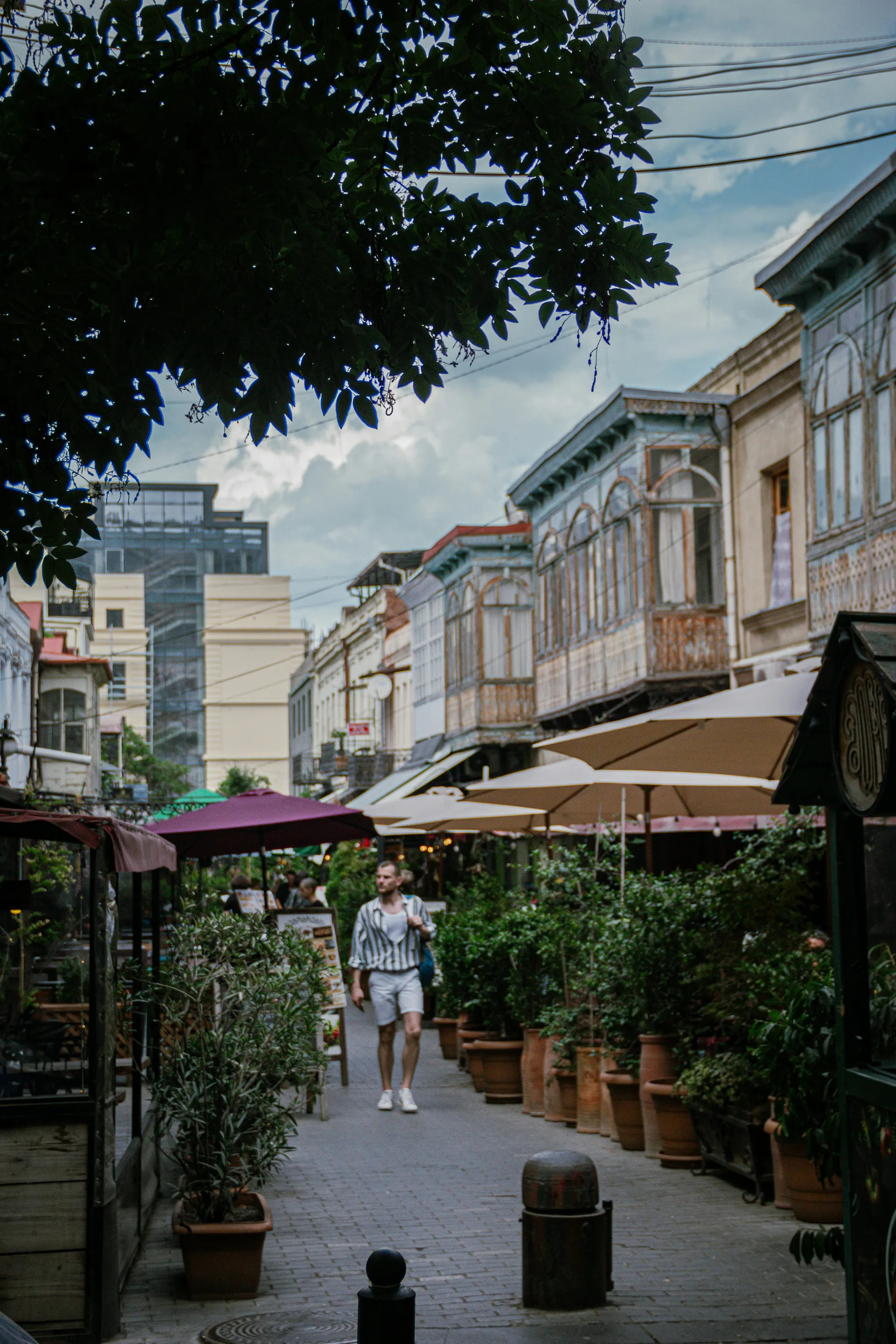
Tbilisi Neighborhoods — Quick Reference
| Neighborhood | Vibe | Rent (1-bed) | Best For |
|---|---|---|---|
| Vake | Upscale, leafy | $500–800 | Families, professionals |
| Vera | Bohemian, charming | $450–700 | Creatives, couples |
| Saburtalo | Residential, practical | $350–550 | Budget-conscious, long-term |
| Marjanishvili | Hip, central | $400–650 | Nightlife, social nomads |
| Old Tbilisi / Sololaki | Historic, touristy | $450–700 | Short-term, atmosphere seekers |
| Dighomi / Gldani | Soviet-era, cheap | $250–400 | Tight budget, less social |
The advice: Start in Vake or Vera on a short-term Airbnb (1–2 weeks). Walk the neighborhoods. Then find a long-term rental once you know what you want. Never sign a lease sight-unseen from abroad.
Deep dives: Tbilisi Neighborhoods Guide · Renting an Apartment · Buying Property
Cost of Living
Georgia is cheap by Western standards, but it's not as cheap as it was five years ago. Tbilisi has gentrified significantly, and expat-heavy areas charge expat prices. That said, if you shop at local bazaars, eat Georgian food, and avoid the Instagram cafés, your money goes far.
Monthly Budget — Comfortable Single Person
Winter Warning
Gas heating costs spike from November to March. A poorly insulated Soviet-era apartment can cost $150–200/month in gas alone during January. Euro-renovated apartments with central heating are far more efficient. Ask about heating costs before signing a lease.
Full breakdown: Cost of Living in Tbilisi
Business Setup and Taxes
This is Georgia's killer feature for digital nomads and entrepreneurs. The setup is genuinely fast, cheap, and the tax rates are some of the lowest in the world — legally.
Two Main Structures
Individual Entrepreneur (IE)
Tax: 1% on gross revenue (up to 500,000 GEL/year)
Setup: 1 day at Public Service Hall, ~20 GEL
Best for: Freelancers, consultants, remote workers
Downside: Unlimited personal liability
LLC (შპს)
Tax: 15% corporate tax, but only on distributed profits (0% if reinvested)
Setup: 1–2 days, ~200 GEL total
Best for: Businesses with employees, higher revenue, or liability concerns
Downside: More bookkeeping, mandatory audit above thresholds

The 1% Trap
Some expats think they can just work remotely and not register anything — "I'm not earning money in Georgia." Wrong. If you're physically in Georgia and earning income, Georgia considers you a tax resident after 183 days. Without IE or LLC registration, the default rate is 20% personal income tax. Register properly on day one.
Deep dives: Starting a Business · Tax Guide
Banking
Georgia has two main banks: Bank of Georgia (BoG) and TBC Bank. Both offer multi-currency accounts (GEL, USD, EUR), debit cards, and decent mobile apps. Opening an account takes 30 minutes with your passport.
| Feature | Bank of Georgia | TBC Bank |
|---|---|---|
| Account opening | Walk-in with passport | Walk-in with passport |
| Currencies | GEL, USD, EUR, GBP | GEL, USD, EUR, GBP |
| App quality | Good | Slightly better |
| SWIFT transfers | $15–30 per transfer | $15–30 per transfer |
| Business accounts | IE or LLC required | IE or LLC required |
| Crypto-friendly | Tolerated, not promoted | More open |
Keep Wise as Backup
Georgian banks charge high fees for international transfers. Many expats keep a Wise (TransferWise) account for receiving payments from abroad, then transfer to their Georgian bank when they need GEL. The exchange rate is significantly better than what the banks offer.
Full guide: Banking in Georgia
Healthcare and Insurance
Georgian healthcare is a mixed bag. Private clinics (Evex, MediClub, National Center of Surgery) are modern, affordable by Western standards, and handle routine care well. A GP visit costs $15–30. Blood work: $20–50. Dental cleaning: $30–50.
The problems start with specialists and complex procedures. Quality varies wildly. Communication can be an issue — not every doctor speaks English. For anything serious (complex surgery, oncology, fertility treatments), many expats fly to Istanbul, which is a 2-hour flight away.
| Insurance Type | Cost/Month | Coverage |
|---|---|---|
| Local private (Ardi, Imedi L) | $30–80 | Georgia only, covers 70–80% of common procedures |
| International (Cigna, Allianz) | $100–300 | Worldwide coverage, medevac, major procedures |
| SafetyWing (nomad insurance) | $45–70 | Good for basics, limited coverage for pre-existing conditions |
Full guide: Healthcare in Georgia
The Relocation Checklist
Here's the practical sequence. Work through this in order and you'll be fully set up within your first two weeks.
Before You Arrive
✈️ Book a one-way flight
Tbilisi (TBS) is the main airport. Kutaisi (KUT) has budget airlines. You don't need a return ticket — immigration doesn't ask.
🏠 Book 1–2 weeks of accommodation
Airbnb in Vake or Vera. Don't sign a long-term lease from abroad. Walk the neighborhoods first.
📋 Prepare documents
Passport (valid 6+ months), any apostilled documents you might need (marriage certificate, degree), and digital copies of everything.
💳 Bring backup payment methods
Wise card, Revolut, or a bank card with no foreign transaction fees. ATMs are everywhere but Georgian banks charge 1–2% withdrawal fees.
Week 1 — Essential Setup
📱 Get a SIM card
Magti or Geocell at the airport or any phone shop. Passport required. Unlimited data plans start at 8 GEL (~$3). Takes 5 minutes.
🏦 Open a bank account
Bank of Georgia or TBC. Walk into any branch with your passport. Multi-currency account. 30 minutes. Free debit card.
🏢 Register your business (if applicable)
Go to Public Service Hall with your passport. IE registration takes 1 day and costs ~20 GEL. Apply for Small Business Status (1% tax) at Revenue Service.
🏥 Get health insurance
Either local private (Ardi, Imedi L) or international (SafetyWing, Cigna). Don't skip this — even minor emergencies are stressful without coverage.
New: Labour Permit Required from March 2026
As of March 2026, foreign nationals who register as Individual Entrepreneurs, actively run a Georgian company, or get employed by a Georgian company need to deal with the Right to Work system before they can legally operate. Remote workers for foreign companies without Georgian employment ties are generally exempt. Self-employed cases now use self-employment.moh.gov.ge, while employer-sponsored cases use the labour-migration portal. Budget 200 GEL for the standard lane or 400 GEL for the faster lane, and factor it into your first-week business setup plan. Full details in our labour permit guide.
Week 2 — Get Settled
🏠 Find long-term housing
Check SS.ge (Georgian), MyHome.ge, and Facebook groups. Always visit in person. Negotiate — listed prices are starting points, not final offers.
📦 Set up home internet
Magticom or Silknet. 100 Mbps fiber runs 40–60 GEL/month. Installation takes 1–3 days. Your landlord might already have a connection.
📲 Download essential apps
Bolt (taxi), Glovo/Wolt (delivery), Google Maps (navigation), Bank of Georgia/TBC (banking), Google Translate (survival).
🤝 Find your community
Join "Expats in Tbilisi" and "Digital Nomads Tbilisi" Facebook groups. Check out coworking spaces (Terminal, Impact Hub, Spaces). Attend meetups.
Practical Tips for Your First Month
| Topic | What to Know |
|---|---|
| Money | The currency is the Lari (GEL). Roughly 2.7 GEL = $1. Cards are accepted almost everywhere in Tbilisi. Cash is still useful at bazaars and small shops. |
| Transport | Get a Metromoney card (reusable transit card) — works on metro and buses. Metro costs 1 GEL per ride. Bolt taxis are cheap: most rides within the center are 3–8 GEL. |
| Groceries | Carrefour, Goodwill, and Nikora are the main supermarket chains. The Dezerter Bazaar has the freshest and cheapest produce. Local bread (shotis puri) from a tone oven is unmissable. |
| Language | Learn "gamarjoba" (hello), "madloba" (thanks), and "ar vici" (I don't know). Even basic efforts are deeply appreciated. Google Translate camera mode is your friend for menus and signs. |
| Safety | Tbilisi is very safe for its size. Petty crime exists but violent crime is rare. The main dangers are traffic (seriously — look both ways twice) and stray dogs in outer neighborhoods. |
| Culture | Accept every dinner invitation. Say yes to wine. Georgians will overfeed you and consider it rude if you refuse. A "supra" (feast) is the best way to experience the real Georgia. |
| Winter | December–February is cold (0–8°C) and gray. Apartments with central heating are worth the premium. January is the worst month — short days, bad air, and muddy streets. |
| Best time to arrive | April–May or September–October. Perfect weather, the city is alive, and you'll see Georgia at its best. Avoid arriving in January unless you like a challenge. |
Common Mistakes Expats Make
❌ Not registering as IE
Working remotely without registering means you're technically liable for 20% income tax instead of 1%. It takes one day to fix — do it immediately.
❌ Signing leases sight-unseen
Apartment photos lie. "Euro renovation" can mean anything from beautiful to terrifying. Always visit in person, check water pressure, heating, and ask about the building's condition.
❌ Ignoring heating costs
That cheap apartment becomes expensive in winter when the gas bill hits $150–200/month because of single-pane windows and no insulation. Ask about winter utility costs.
❌ Expecting Western service
Customer service isn't a Georgian strong suit. Things take longer than promised. Rules get made up on the spot. Patience isn't optional — it's a survival skill.
❌ Living only in the expat bubble
It's easy to eat at the same 10 cafés, hang out with other nomads, and never experience real Georgia. Push yourself to learn basic Georgian, shop at bazaars, and accept invitations from locals.
❌ Not getting health insurance
Healthcare is cheap, but an emergency surgery or medevac is not. Even a basic SafetyWing plan ($45/month) gives you peace of mind. Don't be that person in the Facebook group asking for donations.
Is Georgia Right for You?
Georgia works brilliantly for a specific profile. Here's an honest assessment:
✅ Great fit if you…
- • Work remotely or run an online business
- • Value low taxes and simple bureaucracy
- • Enjoy food, wine, and mountains
- • Are adaptable and patient with chaos
- • Want a high quality of life on a moderate budget
- • Don't need to be in a global metropolis
❌ Not ideal if you…
- • Need a large English-speaking social circle
- • Have serious medical conditions requiring specialist care
- • Can't tolerate bad driving and chaotic traffic
- • Want a well-established international school system
- • Need direct flights to North America or Asia
- • Are uncomfortable with political uncertainty
Frequently Asked Questions
Do I need to speak Georgian?
No, you can survive on English in central Tbilisi. But your quality of life improves dramatically with even basic Georgian. It opens doors with locals, helps with bureaucracy, and shows respect for the culture.
Can I drive with my foreign license?
Yes, for up to one year. After that, you need a Georgian license. An International Driving Permit (IDP) is recommended but not strictly required. Fair warning: driving in Tbilisi is not for the faint of heart.
Is Georgia safe?
Very safe by regional standards. Tbilisi has lower violent crime rates than most European capitals. The main safety concerns are traffic, stray dogs in suburban areas, and occasional petty theft in tourist zones.
Can I bring my pet?
Yes. Dogs and cats need a microchip, rabies vaccination (at least 21 days before travel), and a veterinary health certificate. No quarantine required. Georgia is very dog-friendly — there are stray dogs everywhere, and Georgians generally love animals.
What about schooling for kids?
There are a handful of international schools in Tbilisi (QSI, British-Georgian Academy, European School). Tuition ranges from $5,000–15,000/year. The options are limited compared to Dubai or Bangkok, but they exist and are growing.
Written by The Georgia Expats Team
We've been through the entire relocation process ourselves — the visa runs, the bank account bureaucracy, the apartment hunting, the gas bill shock. This guide is what we wish someone had handed us before we got on that plane.
Last updated: February 2026.
Related Articles
Cost of Living in Tbilisi
Real numbers and sample budgets for every lifestyle.
Starting a Business in Georgia
IE vs LLC, registration steps, and real costs.
Best Neighborhoods in Tbilisi
Where to live — rent prices, vibes, and pros/cons.
Leaving Georgia
Closing bank accounts, taxes, and everything to handle before you go.
Visa & Residency in Georgia
Visa-free entry, residence permits, and work permits.