
Georgia has one of the most generous immigration policies in the world. Citizens of 98 countries can stay for a full year without a visa. You can work, freelance, start a business, or just exist — no questions asked for 365 days. No other country offers anything quite like it.
But "visa-free" doesn't mean "figure-it-out-free." If you want to stay longer than a year, get a residence permit, navigate the new 2026 labour permit system, or understand the major immigration reforms that are tightening Georgia's historically relaxed approach — things get more nuanced. This guide covers all of it, from your first border crossing to permanent residency.
Visa-Free Entry: The 1-Year Stay
Georgia grants visa-free entry for up to 365 days to citizens of 98 countries, including all EU member states, the UK, USA, Canada, Australia, New Zealand, Japan, South Korea, and most other developed nations. You don't need to apply for anything — just show up with a valid passport.
This isn't a tourist visa. There's no restriction on what you can do during this year. You can freelance, work remotely, register as an Individual Entrepreneur, open a bank account, sign a lease, and live a completely normal life. Georgia is one of the only countries in the world where "visa-free" genuinely means freedom to operate.
What You Need at the Border
| Requirement | Details |
|---|---|
| Passport | Valid for at least 1 day beyond your stay (Georgia is lenient, but don't push it) |
| Return ticket | Not required — rarely checked |
| Proof of funds | Not required — rarely checked |
| Health insurance | Required since Jan 2026 (30,000 GEL minimum) — enforcement varies |
| COVID vaccination | Not required since 2023 |
New for 2026: Tourist Insurance Requirement
Since January 1, 2026, all tourists entering Georgia must provide proof of health and accident insurance with minimum 30,000 GEL coverage. If you're on the 365-day visa-free stay, you technically fall under this rule. Enforcement at borders has been inconsistent so far, but it's the law. If you have a residence permit, you're exempt. For the practical border-entry version, read our Georgia travel insurance requirement guide.
Countries NOT Eligible for 1-Year Visa-Free Entry
If your country isn't on the visa-free list, you'll need a visa before arrival. Georgia offers e-visas for many nationalities through evisa.gov.ge. Citizens of GCC countries (UAE, Saudi Arabia, Qatar, etc.) with a valid GCC residence permit can enter visa-free for 90 days. Citizens of India, China, Nigeria, Pakistan, and many other countries need to apply through the e-visa portal or a Georgian embassy.
| Visa Type | Duration | Purpose | Where to Apply |
|---|---|---|---|
| C (short-term) | Up to 90 days | Tourism, business, transit | evisa.gov.ge or embassy |
| D1 (work) | Up to 1 year | Employment, self-employment | Embassy (requires labour permit from March 2026) |
| D2 (study) | Duration of studies | Enrolled at Georgian institution | Embassy |
| D3 (family) | Up to 1 year | Family reunification | Embassy |
| T (transit) | Up to 10 days | Transit through Georgia | evisa.gov.ge |
Border Runs: The Practical Reality
Many expats simply leave Georgia before their 365 days expire, re-enter, and get a fresh year. This is legal, widely practiced, and border agents are accustomed to it. A quick trip to Armenia, Turkey, or Azerbaijan resets the clock.
But border runs are getting riskier. Georgia introduced an illegal presence database in October 2025, significantly raised overstay fines in September 2025, and the general trajectory is toward tighter controls. The 365-day policy is generous and unlikely to change overnight, but relying on it indefinitely without a residence permit is a gamble.
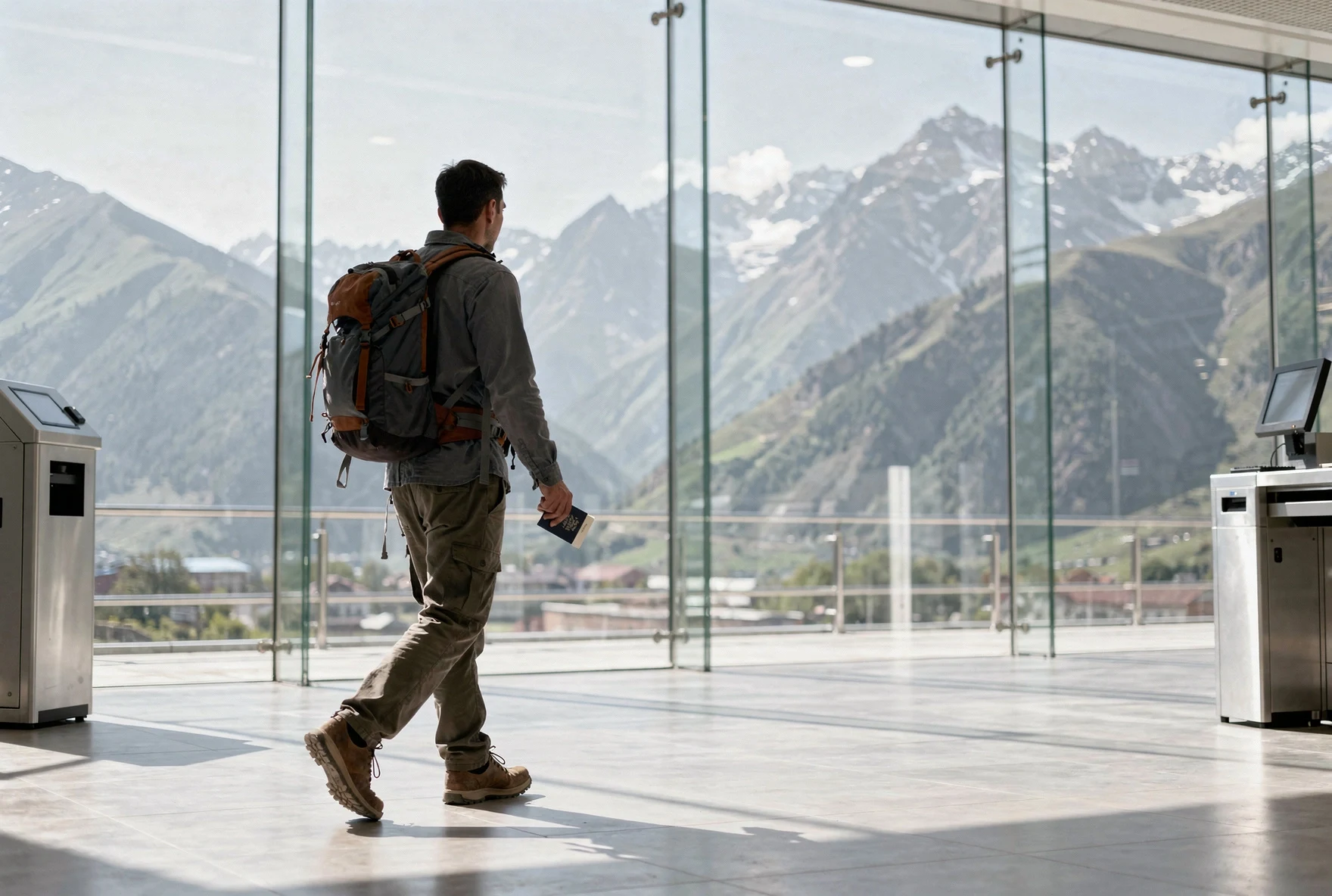
Where to Do a Border Run
| Destination | Best Crossing | Time from Tbilisi | Cost (Round Trip) | Notes |
|---|---|---|---|---|
| Armenia | Sadakhlo/Bagratashen | 2–3 hours | 40–80 GEL by marshrutka | Most popular. Can turn around same day. |
| Turkey | Sarpi (from Batumi) | 5–6 hours to border | 50–100 GEL by bus | Walk across at Sarpi. Good excuse for a Batumi weekend. |
| Turkey (direct) | Tbilisi–Trabzon bus | 8–10 hours | 70–120 GEL | Overnight buses available. Vale/Aktau land crossing. |
| Azerbaijan | Red Bridge / Lagodekhi | 3–5 hours | 40–80 GEL by marshrutka | Need Azerbaijan e-visa ($20). More hassle than Armenia. |
| By air (anywhere) | Tbilisi Airport | Varies | From ~100 GEL (Kutaisi budget airlines) | Wizz Air from Kutaisi often cheapest. Any exit/re-entry works. |
The Armenia Same-Day Run
The fastest border run is Tbilisi → Sadakhlo border → step into Armenia → turn around → re-enter Georgia. You can do the whole thing in 4–5 hours. Take a marshrutka from Ortachala bus station toward Yerevan and get off at the border. Stamp out of Georgia, walk across, stamp into Armenia, immediately stamp out, walk back, stamp into Georgia. Done. Some expats take a Bolt to Marneuli and a taxi from there to the border for more flexibility.
Border Runs Won't Last Forever
Georgia's 365-day visa-free policy is exceptionally generous and historically stable. But the trend is clearly toward tighter immigration control. During COVID-19, many expats who relied on border runs were stranded. If Georgia ever moves to a 90/180-day system (common in the EU), you'd have very little warning. A residence permit gives you legal security that no border run can match.
Residence Permits: Staying Beyond One Year
If you want long-term stability in Georgia — no annual border runs, no worrying about policy changes — you need a residence permit. These are issued by the Public Service Hall (PSH), that futuristic mushroom-shaped building on the Kura River.
Georgia offers several types of residence permits. The right one depends entirely on your situation.
| Permit Type | Duration | Key Requirement | Path to Permanent |
|---|---|---|---|
| Work | 6 months – 6 years | Employment or IE with 50K+ GEL turnover | 10 years → permanent |
| IT sector (new) | 3 years (renewable to 12) | 2+ years IT experience, $25K+ income | 10 years → permanent |
| Property ($150K+) | 1 year (renewable) | Own property worth $150K+ (up from $100K) | 10 years → permanent |
| Investment ($300K+) | 5 years | Investment of $300K+ in Georgia | 5 years → permanent |
| Family reunification | Up to 6 years | Married to Georgian citizen/resident | 10 years → permanent |
| Study | Duration of studies | Enrollment in Georgian institution | Doesn't count toward permanent |
| Permanent | Indefinite | 6–10 years legal residence + language test | — |
Work Residence Permit (Most Common for Expats)
This is the permit most long-term expats end up with, whether they're employed by a Georgian company or running their own IE/LLC. The requirements are more specific than most guides admit.
Need the full work-based route?
This big residency guide gives the overview. If you already know you are applying on work grounds, read the dedicated work residence permit guide for the 2026 sequence, turnover logic, fees, and Public Service Hall workflow.
| Requirement | Details |
|---|---|
| Employment contract | At least 6 months remaining. Applies even if you own the IE/LLC. |
| Turnover threshold | 50,000 GEL per foreigner in the past 12 months. For educational/medical: 35,000 GEL. |
| Minimum income | 5× Georgian subsistence minimum = ~1,300 GEL/month (~$475) |
| Legal presence | At least 40 days remaining on your current legal stay |
| Labour permit (from March 2026) | Must obtain "Right to Work" before applying for residence |
| Police clearance | Increasingly required — get one from each country you've lived in |
The 50K GEL Turnover Rule
This is the requirement that trips up many IE holders. Your business must show 50,000 GEL turnover in the last 12 months for each foreigner in the business. For a solo IE, that's roughly $18,500/year — achievable for most remote workers, but you need to actually run the income through your Georgian business bank account. Turnover is proven via VAT statement from Revenue Service, or a bank statement if you're not VAT-registered.
Property Residence Permit ($150K+)
Own real estate in Georgia worth at least $150,000 (equivalent in GEL, certified by an accredited appraiser) and you qualify for a short-term residence permit — renewable annually. This can include a single property or a portfolio totaling the threshold.
What Changed in March 2026
The minimum was raised from $100,000 to $150,000 as of March 1, 2026. If you already had a property-based permit at the old threshold, you can renew without a new appraisal — as long as you keep the same property.
Family Members Included
Your spouse and dependent children can also get residence under your property permit. They apply separately, after your permit is approved. There's no age limit for children, but they must be dependents.
Sell the Property, Lose the Permit
If you sell the property that your residence permit is based on, the permit is invalidated. This also means you can't buy, get the permit, then flip the property. The ownership must be continuous. If you're buying property primarily for residency, plan to hold it long-term.
Investment Residence Permit ($300K+)
The premium option. Invest $300,000+ in Georgia — in real estate, a business, or government-approved projects — and you get a 5-year temporary residence permit with a fast track to permanent residency. After 5 years (instead of the usual 10), you can apply for permanent status.
| Feature | $150K Property Permit | $300K Investment Permit |
|---|---|---|
| Initial duration | 1 year | 5 years |
| Renewals needed | Annually | Once (after 5 years → permanent) |
| Path to permanent residency | 10 years | 5 years |
| Family members | Spouse + dependent children | Spouse + dependent children (immediate) |
| Investment types | Real estate only | Real estate, business, state projects |
| Must maintain investment | Yes — sell = lose permit | Yes — continuously |
Family Reunification Permit
If you're married to a Georgian citizen or to a foreigner who already holds a Georgian residence permit, you can apply for family reunification. This is the easiest path for spouses.
| Document | Details |
|---|---|
| Marriage certificate | Apostilled and translated into Georgian |
| Sponsor's residence/citizenship proof | Their Georgian ID, residence permit, or citizenship certificate |
| Proof of income | Sponsor or applicant must show 550 GEL/month, OR bank balance of 550 × months of permit |
| Sponsor's permit validity | Must have at least 6 months remaining to sponsor a family member |
"Family member" is defined narrowly: spouse, underage children, or parents of a minor child. Adult children, siblings, and parents of adult applicants don't qualify. If you got married in Georgia, your marriage certificate from the PSH is already in Georgian and doesn't need translation — one less step.
IT Sector Residence Permit (New in 2025)
Georgia created a dedicated "nomad residence permit" for IT professionals, operational since September 2025. It's designed to attract digital workers with a simpler path than the standard work permit.
Requirements
Minimum 2 years IT experience, confirmed income of $25,000+/year, must spend 183+ days per year in Georgia. Failure to meet the 183-day rule means permit cancellation.
Benefits
3-year initial period (vs. 6–12 months for standard work permits). Renewable up to 12 years. Family members can apply under the same scheme. Clear pathway for tech workers.
The Application Process (Step by Step)
All first-time residence permit applications must be submitted in person at the Public Service Hall while you're legally in Georgia. Here's exactly what to expect:
Step 1: Gather Documents
Passport, application form, 3.5×4.5cm photos, proof of grounds (contract, marriage cert, property deed, etc.), address confirmation, police clearance certificates from every country you've lived in, and fee receipt.
Step 2: Get Labour Permit (if required)
From March 2026, you need a "Right to Work" from labourmigration.moh.gov.ge before applying for a work or IT residence permit. This adds 10–30 days. Full details here.
Step 3: Submit at PSH
Visit the main Public Service Hall in Tbilisi (on the Kura River, near Baratashvili Bridge). The operator registers your application and processes payment. Bring all originals — they'll make copies.
Step 4: Wait for Decision
10–30 calendar days depending on the fee. Check status online at sda.gov.ge. You can leave Georgia during processing — but being here for any follow-up questions is smart.
Step 5: Apply for Residency Card
Once approved, apply for your physical card within 1 month. Card issuance: 1–10 business days (60–150 GEL). Without the card, the permit is useless in practice.
Step 6: Get Your Georgian ID Number
Your residency card gives you a Georgian personal number (like a social security number). This makes everything easier — banking, utilities, SIM cards, online services.
Don't Forget the Card
After your permit is approved, you must apply for your physical residency card within 1 month. If you wait more than 6 months, your permit can be revoked. The permit approval and the physical card are separate steps — this catches people off guard.
Fees at a Glance
Residence Permit Application Fees
Residency Card Fees
Labour Permit Fees (from March 2026)
Required Documents (All Permit Types)
| Document | Notes |
|---|---|
| Valid passport | Must be valid at time of application (even 1 day counts, but more is better) |
| Application form | Available at PSH or download from sda.gov.ge |
| Two photos (3.5×4.5cm) | Recent, color. Photo booths available inside PSH. |
| Proof of grounds | Employment contract, marriage cert, property deed, enrollment letter, etc. |
| Address confirmation | Lease agreement or property document |
| Police clearance certificate | From each country you've lived in — increasingly required since 2025 |
| Labour permit approval | Required for work/IT permits from March 2026 |
| Government fee receipt | Can be paid by card at PSH after submission |
All foreign documents must be apostilled (or legalized) and translated into Georgian by a certified translator. Translation offices are clustered right outside the PSH — expect to pay 20–50 GEL per page.
The 2025/2026 Immigration Reforms: Everything That Changed
Georgia's immigration system is undergoing its biggest overhaul in a decade. If you're relying on outdated information from 2023 blog posts, you could be in for serious surprises. Here's what changed.
🔍 Stricter Scrutiny (2025)
Authorities are conducting more detailed reviews of residence permit applications. Background checks and police clearance certificates are now standard practice, not optional. If you need the Georgian-side document itself, use our police clearance certificate guide so you do not lose time at the wrong office or forget the apostille step for use abroad.
🗃️ Illegal Presence Database (Oct 2025)
A national database now tracks foreigners who are or have been illegally present. Overstaying gets permanently recorded and can affect future applications.
🖐️ Biometric Collection (2025)
The government expanded authority to collect fingerprints and palmprints. They can also inspect residences and workplaces.
💻 IT Residence Permit (Sep 2025)
New dedicated permit for IT workers. 3-year validity, $25K income requirement, 183-day presence rule.
🏠 Property Threshold Raised (Mar 2026)
Minimum for property-based residence went from $100,000 to $150,000. Existing permit holders can renew at the old threshold if they keep the same property.
📋 Labour Permits Required (Mar 2026)
All foreign workers and self-employed (including IE holders) now need a "Right to Work" from the Ministry of Labour before they can get or renew a work residence permit. Full guide here.
New Overstay Fines (Since September 2025)
Georgia dramatically increased penalties for overstaying. The old fines of 180–360 GEL are gone. Here's what you face now:
| Overstay Duration | Fine | Entry Ban |
|---|---|---|
| Up to 6 months | 1,000 GEL (~$365) | Up to 1 year |
| 6–12 months | 2,000 GEL (~$730) | Up to 2 years |
| More than 1 year | 3,000 GEL (~$1,100) | Up to 3 years |
This Is Not a Joke
The old fines were practically an "exit tax" — people shrugged and paid 360 GEL on the way out. The new fines plus entry bans make overstaying genuinely risky. If you're within a month of your 365-day limit, do a border run or apply for a permit immediately.
Labour Permits: The Biggest Change in Years
As of February 20, 2026, Georgia requires a "Right to Work" labour permit for all foreign nationals employed by Georgian businesses or self-employed in Georgia. This was established by Government Ordinance No. 70 and fundamentally changes how the IE and work permit system operates.
| Who Needs It | Who's Exempt |
|---|---|
| IE holders | Permanent residence permit holders |
| LLC directors/partners | Investment residence permit holders |
| Employed by Georgian company | Diplomats, international org staff |
| Self-employed contractors | Remote workers for foreign companies (no Georgian IE) |
Self-employed foreigners should now use self-employment.moh.gov.ge. The process includes submitting business information, turnover documents from Revenue Service (or a business plan for new businesses), and sometimes a short video call with a government representative. Cost: 200 GEL standard (30 days) or 400 GEL expedited (10 business days). We break down the full portal flow in our self-employment registration guide.
Some professions are completely blocked: couriers, taxi drivers, and tourist guides have a zero quota. Mountain/ski guides have a quota of 200 per year.
The penalty for working without a permit: 2,000 GEL. Repeat violations: double or triple the fine.
Remote Workers: Likely Exempt
If you work remotely for a foreign company with no Georgian employment contract or IE registration, you're likely exempt. But if you have a Georgian IE — even "just for taxes" — you likely need the permit and should use the self-employed portal rather than the employer flow. This is a gray area that's still being tested. Read our self-employment portal walkthrough and the complete labour permit guide for the full breakdown.
The Individual Entrepreneur (IE) Setup
This is the setup that put Georgia on the digital nomad map. Register as an Individual Entrepreneur, pay just 1% tax on revenue up to 500,000 GEL (roughly $185,000), and enjoy one of the lowest tax burdens in the world. No corporate tax. No capital gains tax. No dividend tax.
The IE status isn't a visa or residency category — it's a tax registration. But it's so intertwined with the expat experience in Georgia that any visa guide would be incomplete without it.
| IE Detail | What You Need to Know |
|---|---|
| Tax rate | 1% on gross revenue (up to 500K GEL) |
| Registration cost | Free |
| Where to register | Revenue Service office or online at rs.ge |
| Small Business status | Must apply separately — this is what gives you the 1% rate |
| VAT threshold | Mandatory above 100K GEL revenue (18% VAT) |
| Employees | IEs can't hire employees — need an LLC for that |
| Labour permit (2026) | Now required for foreign IE holders |
| Bank account | Need a Georgian bank account — BoG or TBC |
IE ≠ Small Business Status
Registering as an IE does NOT automatically give you the 1% tax rate. You must separately apply for "Small Business" status at the Revenue Service. Without it, you pay standard income tax rates (up to 20%). This is the single most common mistake new expats make. For the full breakdown of how taxes in Georgia work, see our dedicated guide.
Tax Residency vs. Legal Residency
This confuses almost every expat. They're completely separate systems.
| Aspect | Tax Residency | Legal Residency |
|---|---|---|
| What is it? | Your tax home — where you owe taxes | Your immigration status — right to stay |
| How to get it | 183+ days/year in Georgia, or pay Georgian tax | Apply at PSH with documents |
| Need both? | Not necessarily | Not necessarily |
| Common combo | Most freelancers have tax residency (IE + 183 days) without a residence permit, using border runs | |
You can be a tax resident without a residence permit (by spending 183+ days per year and registering as an IE), and you can have a residence permit without being a tax resident (if you spend most of your time abroad). Most freelancers and remote workers use the visa-free entry + IE combo and never bother with a residence permit at all — though the new labour permit rules may change that calculus.
The "Remotely from Georgia" Program
Georgia launched its digital nomad program in 2020. Despite the branding, it's essentially a formalized framework for remote workers to use the existing visa-free entry. You don't get any special visa — just official documentation.
| Requirement | Details |
|---|---|
| Income | Minimum $2,000/month |
| Employment | Must work for a company outside Georgia |
| Health insurance | Must cover Georgia |
| Duration | Up to 1 year, renewable |
Most people skip this program entirely. The standard visa-free entry has no income requirements and lets you do everything the program does. The program mainly makes sense if you want official documentation of your remote work status for your home country's tax authorities.
Why Bother with a Residence Permit?
Since the visa-free year is so generous, many expats wonder why they'd go through the hassle. Here are the real reasons:
No More Border Runs
Renew your permit from home — or even from abroad. No more annual trips to Armenia just to reset a clock.
Policy Insurance
If Georgia ever reduces the visa-free period (COVID proved this can happen overnight), permit holders are unaffected. You're building on solid ground.
Georgian ID Number
Your residency card comes with a personal number that makes everything easier — banking, utilities, online services, notary appointments. Many services that require a passport become one-click with a Georgian ID.
Path to Permanent Residency
Only time spent on residence permits counts toward permanent residency (6–10 years). Visa-free stays don't count. If Georgia is your long-term home, start the clock now.
Better Banking
Banks treat residents differently from tourists. Higher transfer limits, easier loan access, and some investment products are only available to residents.
Labour Permit Exemption (Investment)
Investment residence permit holders are exempt from the new labour permit requirements. If you're running a business, this alone might justify the $300K investment.
The Path to Permanent Residency
Permanent residence is where Georgia stops being a repeating admin task and starts being a durable legal base. In practice, the route is built from years spent on valid residence permits — not from years spent living happily on visa-free entry and border runs. Standard long-term residents should think in terms of the full 10-year arc, while the investment route is the shorter premium track.
Want the dedicated long-term-status breakdown?
Read our focused permanent residence guide for what actually counts, what does not, why border-run years are a trap if permanence is the goal, and why this status matters more after the 2026 labour-permit changes.
Requirements
- Long-term legal residence built on proper residence permits rather than visa-free resets
- Knowledge of Georgian language at a practical, basic level
- Basic knowledge of Georgian history and law
- Credible long-term ties, income, or property logic inside Georgia
- No serious criminal record
The language and history tests exist, but the bigger issue is coherence. Your permit history, your life in Georgia, and your integration story should make sense together. If you have spent years improvising between statuses, fix that before assuming permanent residence is a quick final step.
Georgian Citizenship
Citizenship requires 10 years of permanent residence, plus Georgian language proficiency and knowledge of history, law, and the Constitution. The biggest dealbreaker: Georgia doesn't allow dual citizenship (with rare exceptions for extraordinary merit). You'd have to give up your original passport.
Most long-term expats find permanent residency gives them everything they need without that sacrifice.
Planning Your Timeline
| When | What to Do |
|---|---|
| Before arrival | Get police clearance certificates from every country you've lived in. This can take weeks or months. Start early. |
| Months 1–3 | Settle in. Open bank account, get SIM card, find an apartment. Register as IE if freelancing. Explore neighborhoods. |
| Months 3–6 | Decide if you're staying. If yes, start building your residence permit case — turnover, contracts, etc. |
| Months 8–10 | Apply for labour permit (if needed) and then residence permit. Don't wait until month 11 — processing takes up to 30 days, and you need 40 days of legal stay remaining. |
| Month 11 | If you haven't applied for a permit, plan your border run. Armenia same-day run is the easiest option. |
| After permit approval | Apply for residency card within 1 month. Keep all documents filed safely — you'll need them for renewals. |
Common Mistakes Expats Make
❌ Overstaying the 365 Days
With the new illegal presence database and fines up to 3,000 GEL plus entry bans, overstaying isn't the minor inconvenience it used to be. Track your days carefully.
❌ Confusing Tax and Legal Residency
Different systems. You can owe taxes without a residence permit, and hold a permit without owing taxes. Understand both before making decisions.
❌ Forgetting the Residency Card
Permit approved ≠ done. You must apply for the physical card within 1 month. Wait more than 6 months and your permit gets revoked.
❌ Not Getting Documents Apostilled
Foreign documents need apostilles and certified Georgian translations. Get these before you fly — doing it remotely from Georgia is painful and expensive.
❌ Skipping Small Business Status
Registering as an IE doesn't automatically give you the 1% rate. You must separately apply for Small Business status. Without it, you pay up to 20%.
❌ Waiting Too Long to Apply
You need 40 days of legal stay remaining when you submit. Processing takes 10–30 days. If you start at month 11, you might run out of time.
❌ Ignoring the Labour Permit
If you have an IE, you now need a labour permit before you can apply for or renew a work residence permit. The fine for working without one is 2,000 GEL.
❌ Using a Small-Town PSH
The main Tbilisi PSH is the most experienced with foreigner applications. Smaller branches sometimes give conflicting information or aren't sure how to process unusual cases.
Practical Tips for a Smooth Process
Hire a Local Consultant
Companies like ExpatHub and Gegidze specialize in helping foreigners. For residence permits, they're worth every lari — especially with tightening rules. Budget 500–1,500 GEL.
Get Police Clearance Early
If you've lived in multiple countries, PCCs can take weeks or months. UK takes 2–4 weeks, US FBI checks take 12–16 weeks. Start before you even arrive in Georgia.
Use the Tbilisi PSH
The main branch on the Kura River is best for foreigner applications. Bring all originals — they may need copies you didn't expect.
Bring Cash for Translations
Translation offices outside PSH charge 20–50 GEL per page. Many only accept cash. Budget 100–200 GEL for translation fees.
Keep Copies of Everything
Digital and physical copies of every document you submit. Georgian bureaucracy occasionally loses things, and you'll need everything again for renewals.
Renewals Can Be Done Remotely
After your first permit, renewals can be submitted online from abroad (if your current permit is still valid). But you'll still need to send original documents physically.
Already have a permit and just need the renewal workflow?
Use the dedicated residence permit renewal guide for timing, remote renewal from abroad, work-permit dependency in 2026, and the new-card step people forget.
Which Path Is Right for You?
| Your Situation | Recommended Path | Estimated Cost |
|---|---|---|
| Digital nomad, 1 year or less | Visa-free entry. No permit needed. | Free |
| Freelancer, 1–3 years | IE + work permit + residence permit | 500–1,000 GEL/year |
| IT professional | IT sector residence permit (3 years) | 500–1,000 GEL |
| Married to Georgian | Family reunification permit | 300–600 GEL |
| Property buyer ($150K+) | Property-based residence permit | 300 GEL + appraisal |
| Serious about permanent residency | $300K investment permit (5-year fast track) | $300K+ investment + 300 GEL |
| Student | Study residence permit | 300 GEL |
Frequently Asked Questions
Can I work during my visa-free year?
Yes. Georgia's visa-free entry doesn't restrict economic activity. You can freelance, work remotely, or register as an IE. However, from March 2026, IE holders and employees of Georgian companies need a labour permit.
How many times can I do a border run?
No official limit, and many people have done it for years. But with the new database tracking foreign nationals and stricter scrutiny, relying on border runs indefinitely is riskier than it used to be. Consider a residence permit for long-term stability.
Do I need a lawyer for the residence permit?
Not legally required, but highly recommended since the 2025 reforms. A good immigration consultant costs 500–1,500 GEL and can prevent costly mistakes or rejections.
Can I buy property as a foreigner?
Foreigners can buy apartments and commercial property freely. Agricultural land is restricted and usually requires a Georgian LLC. Property ownership alone doesn't grant residency — it must meet the $150K threshold. See our property buying guide.
What happens if I overstay?
Fines of 1,000–3,000 GEL depending on duration, plus entry bans of 1–3 years. You're also recorded in the illegal presence database, which can affect future applications. Don't overstay.
Can I appeal a rejected residence permit?
Yes, but since the 2025 reforms, an appeal does NOT suspend enforcement of the decision. This means if you're ordered to leave, you must leave even while appealing. Get it right the first time — ideally with professional help.
Does my visa-free time count toward permanent residency?
No. Only time spent on a residence permit counts toward the 6–10 year requirement for permanent residency. This is a major reason to get a permit sooner rather than later if Georgia is your long-term home.
Written by The Georgia Expats Team
We've been through the visa-free entry, the IE registration, the residence permit process, and the border runs. This guide is based on years of lived experience navigating Georgian immigration — plus careful tracking of the 2025/2026 reforms as they roll out.
Last updated: February 2026.
Related Articles
Georgia's New Labour Permit System
Who needs it, who's exempt, and how to apply for the Right to Work.
Starting a Business in Georgia
IE vs LLC, registration, and everything you need to get started.
Taxes in Georgia for Expats
The 1% IE tax, tax residency, and what you actually owe.
Banking in Georgia
Opening accounts, cards, and managing money as a foreigner.
Retiring in Georgia
Healthcare, cost of living, visa options, and quality of life for retirees.