Let's be honest: most expats in Georgia don't learn Georgian. They get by with English in Tbilisi's expat bubble, throw out a "gamarjoba" at the corner shop, and call it a day. And honestly? You can live here for years like that. English is surprisingly widespread among under-35s, and between Google Translate and pointing, you'll survive.
But surviving and actually living somewhere are different things. Learn even basic Georgian and doors open — your landlord becomes friendlier, taxi drivers stop overcharging you, you understand what the babushka next door is yelling about (probably the stray cats), and you stop being just another transient foreigner. Georgians are famously warm, but they're different-level warm when you make any effort with their language.
This guide is the honest version. How hard Georgian actually is, what the realistic timeline looks like, which resources are worth your time, and which are a waste. Written by people who've sat through the frustration and come out the other side.
How Hard Is Georgian, Really?
The U.S. Foreign Service Institute ranks Georgian as a Category IV language — the second-hardest tier, alongside Finnish, Hungarian, and Thai. They estimate 1,100 classroom hours for professional-level fluency. For context, Spanish is 600 hours. Arabic and Mandarin are 2,200.
But here's what that number doesn't tell you: you don't need professional fluency to transform your life here. The jump from zero Georgian to "I can navigate daily life" is much shorter than you think. And Georgian has some genuine advantages that make early progress faster than expected.
✅ What's Easier Than Expected
- • Completely phonetic — read it as it's written
- • No grammatical gender
- • No articles (no "the" or "a")
- • No tones
- • Word order is fairly flexible
- • Tons of loanwords from English, Russian, Turkish
❌ What's Genuinely Difficult
- • Unique alphabet (no cognates to recognize)
- • Consonant clusters (გვფრცქვნი — yes, that's one word)
- • The verb system is legendarily complex
- • 7 noun cases (like German on steroids)
- • Very few learning resources compared to major languages
- • Locals often switch to English, killing your practice
The Realistic Take
Most expats who commit to learning reach "daily life conversational" (ordering food, giving taxi directions, basic small talk, understanding the gist of conversations) in 6–12 months of consistent study. Full fluency — reading news, following political debates, understanding regional dialects — takes 3–5 years minimum. Set your expectations accordingly.
The Georgian Alphabet
The Georgian alphabet (Mkhedruli) has 33 letters. It's one of only 14 unique writing systems still in use worldwide. It looks intimidating — the curvy, flowing letters bear zero resemblance to Latin, Cyrillic, or Arabic scripts. But here's the good news: it's one of the most logical alphabets in the world.
Each letter represents exactly one sound. No exceptions. No silent letters. No letters that change pronunciation based on context (looking at you, English "c"). If you can read it, you can pronounce it. If you can hear it, you can write it. This makes Georgian dramatically easier to read than English, French, or even Russian.
| Feature | Georgian | English (for comparison) |
|---|---|---|
| Letters | 33 | 26 |
| Upper/lowercase | No (one case only) | Yes |
| Phonetic | 100% — one letter = one sound | Highly irregular |
| Silent letters | None | Many (knife, psychology…) |
| Direction | Left to right | Left to right |
| Time to learn | 1–3 weeks | N/A (you already know it) |
Most expats learn the alphabet in 1–3 weeks with daily practice. The trick is association: find a visual mnemonic for each letter. For example, ბ (b) looks like a little "b" rotated, and ო (o) is literally a circle. Some letters have no convenient trick — you just have to drill them.
The Street Sign Method
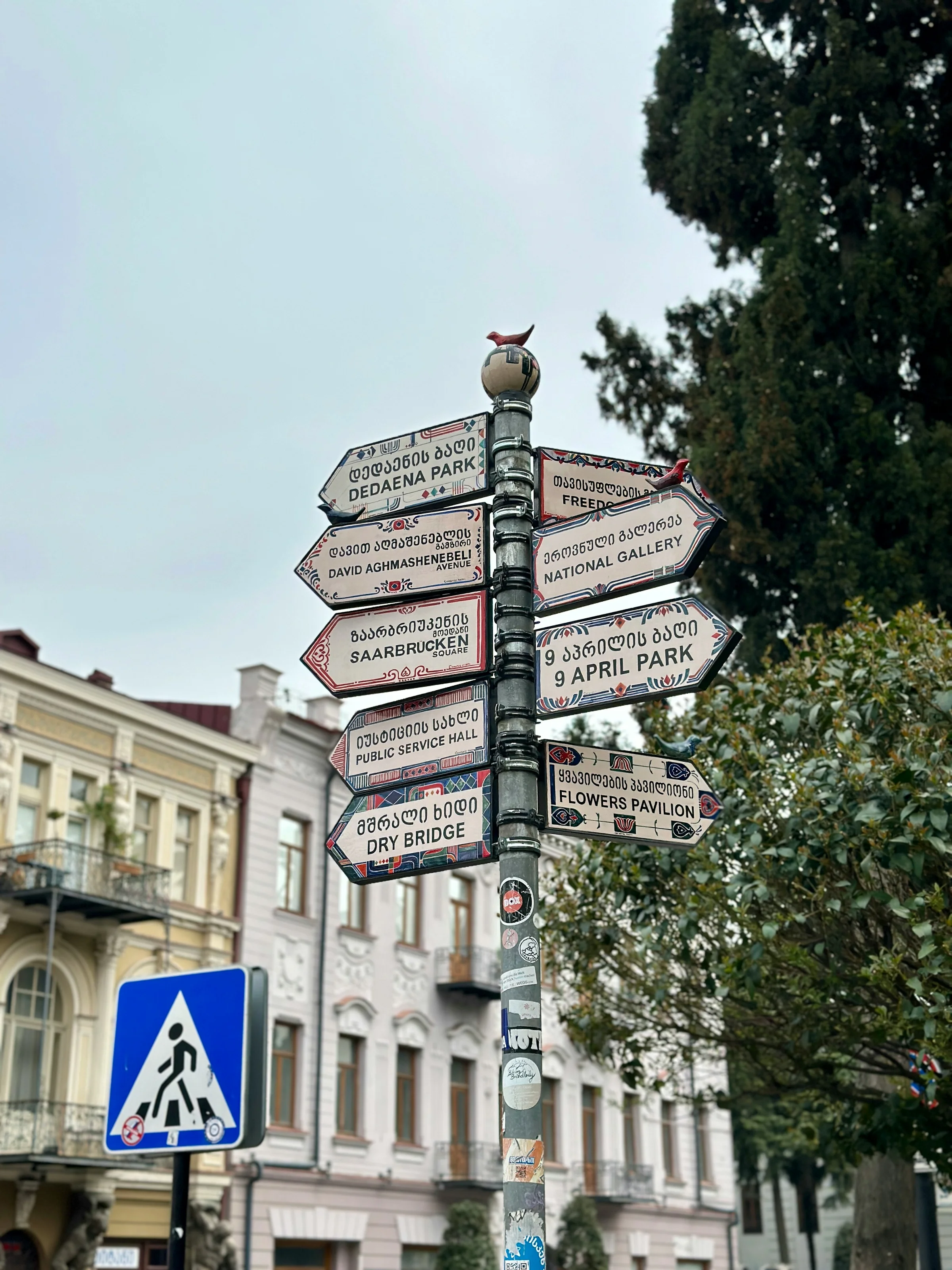
One of the best ways to learn the alphabet: walk around Tbilisi and try to read every sign. Street signs have Georgian and Latin transliteration. Restaurant menus, shop names, metro stations — they're all free flashcards. After a week of doing this, most people can sound out any word, even if they don't know what it means.
Grammar: The Beautiful Monster
If the alphabet is the easy win, Georgian grammar is where things get serious. There's no sugarcoating this: Georgian grammar is objectively one of the most complex in the world. Linguists study it for a reason.
The verb system is the main boss. In English, you conjugate verbs for person and tense — "I go, he goes, I went." In Georgian, verbs encode the subject, the object, the tense, the aspect, the direction, the version (who benefits from the action), and sometimes the causation. A single Georgian verb form can contain information that takes an entire English sentence to express.
| Grammar Feature | What It Means | Difficulty |
|---|---|---|
| Noun cases | 7 cases change word endings based on function (like German, but more) | Medium — you learn them gradually |
| Verb screeves | 11 "screeves" (tense/mood combinations) across 3 series | Very high — the core challenge |
| Preverbs | Prefixes that change verb meaning (like German separable verbs, but worse) | High — must memorize per verb |
| Version vowels | A vowel in the verb tells you who benefits from the action | High — unique to Georgian |
| Ergativity | Subject marking changes based on tense (the "split" system) | High — counterintuitive for English speakers |
| Postpositions | Like prepositions but after the noun (similar to Japanese or Turkish) | Low — straightforward once you know cases |
| No gender | No he/she distinction, no noun genders | Easy — one less thing to memorize |
The practical advice? Don't try to master grammar before you start speaking. Georgian grammar is something you internalize over years of exposure, not something you learn from a textbook in month three. Focus on patterns — learn set phrases, then gradually understand why they work. This is how Georgian children learn it too (they don't fully master the verb system until age 8-9).
Pronunciation: The Consonant Clusters
Georgian is famous for its consonant clusters — sequences of consonants with no vowels between them. The word გვფრცქვნი (gvprtskvni — "you peel us") has eight consonants in a row. These clusters are the thing that makes foreigners' jaws drop and tongues tie.
The ejective consonants are another challenge. Georgian has three ejective stops — წ (ts'), ჭ (ch'), and ყ (q') — which are pronounced with a glottal pop that doesn't exist in European languages. The ყ is universally considered the hardest sound for foreigners. It comes from deep in the throat. Many expats never quite nail it, and Georgians find the attempts endlessly entertaining.
Don't Panic About Pronunciation
Georgians are incredibly forgiving of bad pronunciation. They're so unused to foreigners trying that any attempt gets enthusiastic praise. You'll mangle words for months and get nothing but encouragement. This is one of the best things about learning Georgian — the social reward is immediate.
Best Apps and Online Resources
Here's the honest truth about Georgian learning resources: there aren't many good ones. Georgian has ~3.7 million speakers — that's less than the population of Los Angeles. No Duolingo. No Rosetta Stone. No Pimsleur (yet). You're in niche-language territory, which means you need to be scrappier.
That said, the landscape has improved significantly in the last few years. Here's what's actually worth your time:
| Resource | Type | Cost | Best For |
|---|---|---|---|
| italki | 1-on-1 tutors | $8–20/hr | Speaking practice, structured lessons |
| GEOFL.ge | Website (free) | Free | Grammar, structured curriculum |
| Glossika | AI app | $17/mo | Listening, sentence patterns |
| HelloTalk | Language exchange app | Free (premium optional) | Texting with native speakers |
| 50 Languages | Website + app | Free | Basic vocabulary, audio files |
| Georgian Alphabet apps | Mobile apps | Free | Learning the script |
| Beginner's Georgian (textbook) | Book + audio | ~$30 | Structured grammar, self-study |
| YouTube channels | Video lessons | Free | Pronunciation, alphabet, basics |
📖 Best Textbook
Beginner's Georgian by Dodona Kiziria. The gold standard for English-speaking learners. Covers the alphabet through intermediate grammar with audio. Dry but thorough — treat it as your reference, not your only resource.
🌐 Best Free Resource
GEOFL.ge (Georgian as a Foreign Language). Built by Tbilisi State University linguists. Has structured lessons from A1 to B2 with exercises and audio. The interface is dated but the content is solid. You won't find better free grammar explanations.
The Modern Audio Option
If you want something more structured than the scattered apps above, EasyGeorgian is the closest thing the language has to a proper modern course. It's audio-first, gets you speaking from the first lesson, and includes a free 56-minute alphabet video that has most people reading Georgian inside an hour, plus a comprehensible-input podcast and thousands of flashcards. It won't replace a tutor for grammar, but as a self-study backbone it's a real step up from the bare-bones apps.
Tutors and Schools in Tbilisi
Living in Tbilisi gives you the single biggest advantage for learning Georgian: access to cheap, excellent native tutors. Rates for private lessons typically range from 30–60 GEL per hour ($11–22), which is a fraction of what you'd pay for a tutor in most countries. Many tutors are university-trained linguists with experience teaching foreigners.
| Option | Cost | Format | Notes |
|---|---|---|---|
| Private tutor (in-person) | 30–60 GEL/hr | 1-on-1, flexible schedule | Find via Facebook groups or word of mouth |
| italki tutor (online) | $8–20/hr | Video call | ~20 Georgian tutors available, flexible |
| Language schools | 200–500 GEL/month | Group classes, 2–4x/week | GLT, International House, Lingua Franca |
| University courses | Free–300 GEL/semester | Structured, academic | Tbilisi State (Ivane Javakhishvili) offers courses for foreigners |
| Language exchange | Free | Casual meetups | Facebook groups, café meetups, HelloTalk |
The Best Approach (Expat Consensus)
The expats who actually learn Georgian almost always use the same formula: a private tutor 2–3 times per week ($80–130/month) combined with daily self-study using GEOFL or a textbook, plus real-world practice at every opportunity. Group classes are fine for motivation but too slow for serious progress. Pure app-based learning doesn't work for Georgian — the language is too complex and the app offerings too shallow.
Realistic Timeline
Here's what you can realistically expect at each stage, assuming 30–60 minutes of daily study plus 2–3 tutor sessions per week:
| Timeframe | Level | What You Can Do |
|---|---|---|
| Weeks 1–3 | Pre-A1 | Read the alphabet, basic greetings, numbers 1–10, order coffee |
| Months 1–3 | A1 | Simple sentences, taxi directions, market haggling, introduce yourself |
| Months 3–6 | A2 | Basic conversations, understand simple responses, read menus and signs |
| Months 6–12 | B1 | Follow conversations (slowly), express opinions, handle bureaucracy in Georgian |
| Years 1–2 | B2 | Comfortable conversations, understand TV shows (with effort), read news articles |
| Years 3+ | C1+ | Near-fluency, jokes, slang, regional dialects, professional use |
A reality check: most expats plateau at A2–B1. Life in Tbilisi is perfectly comfortable at this level, English is widely available, and the jump from B1 to B2 requires a massive increase in effort. That's okay. Even A2 Georgian transforms your daily experience here.
Essential Phrases for Expats
These are the phrases you'll actually use every day. Not textbook sentences — real, useful Georgian for navigating life in Tbilisi. Learn these first and you'll handle 80% of daily interactions.
| English | Georgian | Pronunciation |
|---|---|---|
| Hello | გამარჯობა | ga-mar-JO-ba |
| Thank you | მადლობა | mad-LO-ba |
| Yes / No | კი / არა | ki / a-RA |
| How much? | რა ღირს? | ra GHIRS? |
| I don't understand | ვერ გავიგე | ver ga-VI-ge |
| Do you speak English? | ინგლისური იცი? | in-gli-SU-ri i-TSI? |
| Where is…? | სად არის…? | sad A-ris…? |
| Left / Right | მარცხნივ / მარჯვნივ | MARTS-khniv / MARJ-vniv |
| One minute | ერთი წუთი | ER-ti TSU-ti |
| It was delicious | ძალიან გემრიელი იყო | dza-li-AN gem-RI-e-li I-ko |
| Cheers! (toast) | გაუმარჯოს! | gau-MAR-jos! |
| Goodbye | ნახვამდის | na-KHVAM-dis |
| Sorry / Excuse me | ბოდიში / უკაცრავად | bo-DI-shi / u-ka-TSRA-vad |
| I don't know Georgian | ქართული არ ვიცი | kar-TU-li ar VI-tsi |
The Magic Phrase
Learn "ძალიან გემრიელი იყო" (it was very delicious) and use it after every meal. This single phrase will earn you more goodwill than all other phrases combined. Georgians take food seriously, and complimenting the food in Georgian — especially at someone's home — will make you an honorary family member on the spot.

The Russian Question
Should you learn Russian instead of Georgian? This comes up constantly in expat forums, and it's a legitimate question. Russian is still widely spoken in Georgia (especially by anyone over 40), and it unlocks communication across the entire former Soviet Union, not just one country.
Here's the honest assessment:
Learn Georgian If…
- • You're staying in Georgia long-term (2+ years)
- • You care about cultural integration
- • Your social circle includes Georgian friends
- • You're married to or dating a Georgian
- • You want to travel to remote regions
- • You want genuine respect from locals
Learn Russian If…
- • You're here short-term (under a year)
- • You also plan to visit Armenia, Azerbaijan, Central Asia
- • You need to communicate with older Georgians
- • You want more learning resources available
- • You're already partially familiar with Cyrillic
- • Practical utility is your top priority
One important cultural note: Speaking Russian in Georgia is a politically sensitive topic for some people, especially younger Georgians. The country fought a war with Russia in 2008, and Russia still occupies 20% of Georgian territory. Most Georgians won't be offended if you speak Russian to them — it's practical — but learning Georgian will always earn you more respect and warmth than Russian will. If you're here to build a life, Georgian is the right choice.
Common Mistakes Expats Make
🚫 Relying Only on Apps
No app teaches Georgian well enough on its own. The language is too complex and the market too small for quality app content. Apps supplement; they don't replace a tutor and real conversation.
🚫 Trying to Master Grammar First
Georgian grammar will break your brain if you try to understand it all before speaking. Learn phrases as chunks, then deconstruct the grammar later. Pattern recognition beats textbook study.
🚫 Not Practicing Outside Class
You live in Georgia. Use Georgian at the shop, with your taxi driver, with your neighbors. The awkwardness fades. The worst thing you can do is study in isolation when you're surrounded by native speakers.
🚫 Giving Up After the "Easy" Phase
The alphabet takes 2 weeks. Basic phrases take a month. Then you hit the wall — verb conjugation, cases, irregular forms. This is where 90% of expats quit. Push through the 3–6 month plateau and it gets rewarding again.
🚫 Letting Georgians Switch to English
Georgians will switch to English the moment they realize you're foreign. Politely insist: "ქართულად, თუ შეიძლება" (in Georgian, if possible). Most will happily oblige and even help correct you.
🚫 Ignoring the Alphabet
Some expats try to learn Georgian using only transliteration (Latin letters). This is a dead end. The alphabet is easy and opens up everything — menus, signs, apps, messages. Learn it first.
A Practical Study Plan
Based on what actually works for expats in Tbilisi, here's a month-by-month approach:
📅 Month 1: Foundation
- • Learn the alphabet (use app + street signs)
- • Memorize 15–20 essential phrases
- • Find a tutor, start 2x/week
- • Learn numbers 1–100
- • Practice reading everything you see
📅 Months 2–3: Building Blocks
- • Start GEOFL or Beginner's Georgian textbook
- • Learn present tense verbs (the "easy" ones)
- • Build vocabulary: 200–300 common words
- • Practice ordering food, giving directions
- • Start a HelloTalk language exchange
📅 Months 4–6: The Wall
- • Tackle past tense (this is where it gets hard)
- • Learn noun cases through patterns, not rules
- • Watch Georgian content with subtitles
- • Have your first full (slow) conversations
- • Don't quit — this is the hardest phase
📅 Months 6–12: Breakthrough
- • Start reading simple Georgian texts
- • Follow Georgian social media and news (simpler outlets)
- • Make Georgian-speaking friends (not just a tutor)
- • Handle bureaucracy in Georgian (bank, PSH)
- • Celebrate: you're now above 95% of expats
Monthly Cost of Learning
Budget Learner
Intensive Learner
Frequently Asked Questions
Can I live here without learning Georgian?
Yes, especially in Tbilisi. English is widely spoken among young Georgians, and apps like Google Translate bridge most gaps. You can live here for years with zero Georgian, but you'll miss out on deeper connections and always be slightly on the outside.
How long to learn the alphabet?
Most people learn to read Georgian in 1–3 weeks of daily practice. Recognition comes in a few days; confident reading takes a bit longer. It's the easiest part of Georgian since it's perfectly phonetic — one letter, one sound, no exceptions.
Georgian or Russian — which should I learn?
If you're staying long-term: Georgian. It earns enormous respect and opens cultural doors. If you're short-term or plan to travel the broader region: Russian has more practical utility. Many expats learn basic Georgian for daily life and some Russian for communicating with older locals.
Is Georgian related to any other language?
No. Georgian is part of the Kartvelian family, unrelated to any other language family in the world. Not Indo-European, not Turkic, not Semitic. This is part of what makes it both fascinating and challenging — there are zero cognates to leverage from your native language.
What's the best app for learning Georgian?
There's no single great app like Duolingo for Spanish. The best combination: GEOFL.ge (free grammar), HelloTalk (conversation), plus an alphabet app. Glossika ($17/month) is solid for patterns. But no app replaces a human tutor for a language this complex.
Written by The Georgia Expats Team
We've collectively spent years studying Georgian — from tutored lessons to embarrassing market conversations to understanding (most of) what our Georgian in-laws say at dinner. This guide reflects real experience, not language-learning theory.
Last updated: February 2026.
Related Articles
Georgian Culture & Etiquette
The unwritten rules, social norms, and cultural patterns that shape daily life.
Daily Life in Tbilisi
Internet, SIM cards, groceries, transport, and social life.
Moving to Georgia: Relocation Checklist
Everything you need — visa, banking, apartment, business setup — in order.
Remote Work Guide
The 1% tax setup, coworking, internet, and the real cost of nomad life.